




A business may launch a new website and only see the real problem after people begin using it. The design is approved, the pages are working, and the form is sending inquiries as expected. Even so, people come in, read a little, and leave. Sometimes the service is still too broad. Sometimes the useful proof is buried lower on the page. In other cases, the only option is a general contact form that does not feel right for what the visitor needs. These issues are hard to fix with a new button or a few design changes. They usually come from the way the site was planned.
High-converting websites begin with the customer’s next decision. What are they trying to find out? What would make them trust the offer? What should happen if they are ready to move forward? The content, page layout, form, tracking, and response process should be planned around those questions. When they are handled later, the site can be finished on screen while the route through it is still unclear.
How to Build a High-Converting Website with the Right Foundation
Before choosing colors or layouts, decide what a successful visit should produce. For one business, it may be a booked consultation. For another, it could be a completed purchase, quote request, demo registration, or property viewing.
The next step is understanding the visitor. What brought them to the page? What do they already know? What might stop them from acting? A person comparing software providers needs different information from someone ready to request a proposal.
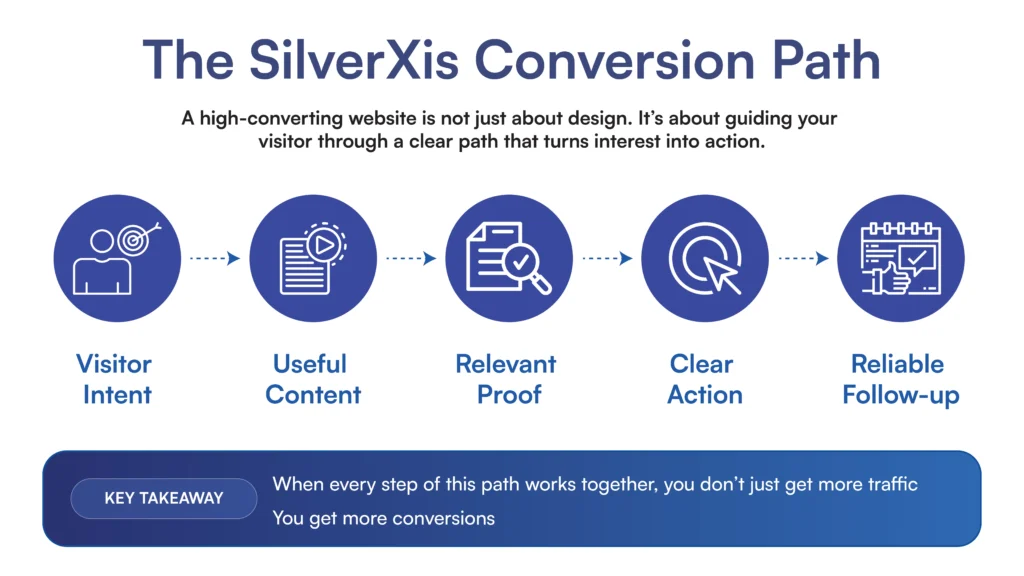
At SilverXis, we look at the full path:
Visitor intent → useful content → relevant proof → clear action → reliable follow-up
The follow-up deserves early attention. Before the homepage is designed, define what happens after someone submits a form. Where does the inquiry go? Who receives it? What information reaches the CRM? How quickly will someone respond?
Planning it this way shows teams how to build a high-converting website around the way the business actually handles a lead, not as a group of pages sitting on their own.
Good design should keep people from getting lost on the page. They should be able to understand the offer and find the next step without searching around.
The Key Elements Every High-Converting Website Needs
Near the top, people should be able to see what the service is, who it is meant for, and what it can help them with. Each important page also needs one main action. A service page might invite the visitor to schedule a consultation. A blog may direct them to a related case study. Asking for several unrelated actions at once can make the decision harder.
Trust should sit close to the claim it supports. Useful proof may include:
- A relevant case study
- A clear delivery process
- Client results with context
- Certifications or industry experience
- Security and privacy information
- An honest explanation of what happens next
Performance and accessibility matter as well. The page can say the right thing and still lose someone over something basic. Maybe it opens slowly. Maybe the text is hard to read. Or the form works on a laptop and becomes awkward on a phone. WCAG 2.2, now recognized as ISO/IEC 40500:2025, gives teams a useful check while the site is being built, not after it is already live.
What visitors need will also change from one industry to another. On a real estate site, that may mean local listings, recent sales, area details, clear service areas, and an easy way to ask about a property. These are some of the key elements of a high-converting real estate agent website.
Common Website Design Mistakes That Hurt Conversion Rates
Conversion trouble often starts with a few small choices made at different points in the project. Each one may seem harmless on its own. Put together, they make the site harder to use.
Common issues include:
- Starting design before defining the audience
- Using broad headlines that could fit any company
- Adding several competing calls to action
- Asking for too much information in the first form
- Hiding case studies or process details
- Using large visual effects that slow mobile pages
- Sending every inquiry to the same inbox
- Tracking pageviews but not form starts, errors, or completions
In many redesigns, the missing piece is not another feature. The problem is an unclear route between the visitor’s question and the company’s next step.
How to Balance User Experience, SEO, and Business Goals
User experience, SEO, and conversion should not be planned by separate teams working at different stages. SEO helps the right visitor find the page. User experience helps that person understand it. The business goal defines what useful action should follow.
Google’s 2025 guidance recommends original, valuable content, a strong page experience, and pages that search systems can access and understand. It also makes clear that content should be built for visitors rather than created only to appear in search results.
For each main page, ask three questions:
- What is the visitor trying to learn or complete?
- What should search engines understand about the page?
- What sensible business action should come next?
A page can rank well and still produce weak leads. It can also look clean but attract little qualified traffic. All three questions need an answer.
The most useful high-converting website examples are not always famous brands. Smaller operational changes often reveal more. A B2B technology company may separate one broad services page into pages built around specific customer problems. Each page can explain the process, show a related case study, and offer a relevant consultation.
High-converting e-commerce websites follow a different path. Product details, delivery costs, returns, stock status, payment confidence, and checkout steps matter more than long company descriptions. A real estate site may need neighborhood pages, recent transaction proof, property alerts, and simple scheduling. The layout changes by industry, but the working principle stays the same: remove uncertainty before asking for action.
The strongest high-converting website examples align the content, proof, and CTA with a specific visitor decision. They do not all use the same layout or feature set.
HubSpot can be useful when a business wants its website, forms, CRM, email follow-up, lead scoring, and reports to stay connected. Still, the platform does not create the strategy. A chatbot cannot repair an unclear offer. Automation cannot improve a form that asks the wrong questions. A heatmap may show where visitors stop, but the team still needs to understand why.
SilverXis helps businesses select and connect tools around the actual customer journey. That may include a CMS, CRM, analytics platform, appointment system, e-commerce platform, or custom integration. The purpose is not to install more software. It is to create a simpler path and collect enough useful data to improve it.
With high-converting websites, it is usually not one big thing that goes wrong. The message may be clear, but the proof comes in too late. Or the form works, but the follow-up after it does not.
SilverXis helps businesses plan those parts before they turn into fixes after launch. The roadmap keeps the build practical by showing what needs to go in now, what can wait, and how the site will work for customers as well as the team handling each lead.
FAQs
What is a good website conversion rate?
A “good” conversion rate can look very different from one site to another. What matters more is what comes from it. A few solid leads that turn into real work can be far more useful than a high percentage filled with poor-fit inquiries.
How soon should conversion testing begin?
Tracking should begin at launch, but teams usually need enough reliable traffic before drawing conclusions. Start by checking broken paths, form errors, mobile issues, and traffic quality before running detailed A/B tests.
Does a custom website convert better than a template?
Not always. A template may be enough when the site is small and the setup is straightforward. Custom development starts to matter when the business needs its own workflows, system connections, user access, data rules, or a customer path that a standard template cannot handle properly.
