

If you have a new app idea buzzing in your mind, that’s incredible, because many successful apps today started with a simple thought: “This should exist.”
But the truth is, most app ideas never become real applications. Not because they’re bad, but because people don’t know what to do next.
If you’ve ever said, “I have an app idea—now what?” This guide will walk you through every step you need to bring that idea to life.
Most mobile app development ideas never become successful apps because of a lack of planning, research, and execution. But with the right roadmap, your concept can evolve into a real, profitable digital product.
10 Proven Steps to bring your mobile app ideas to reality
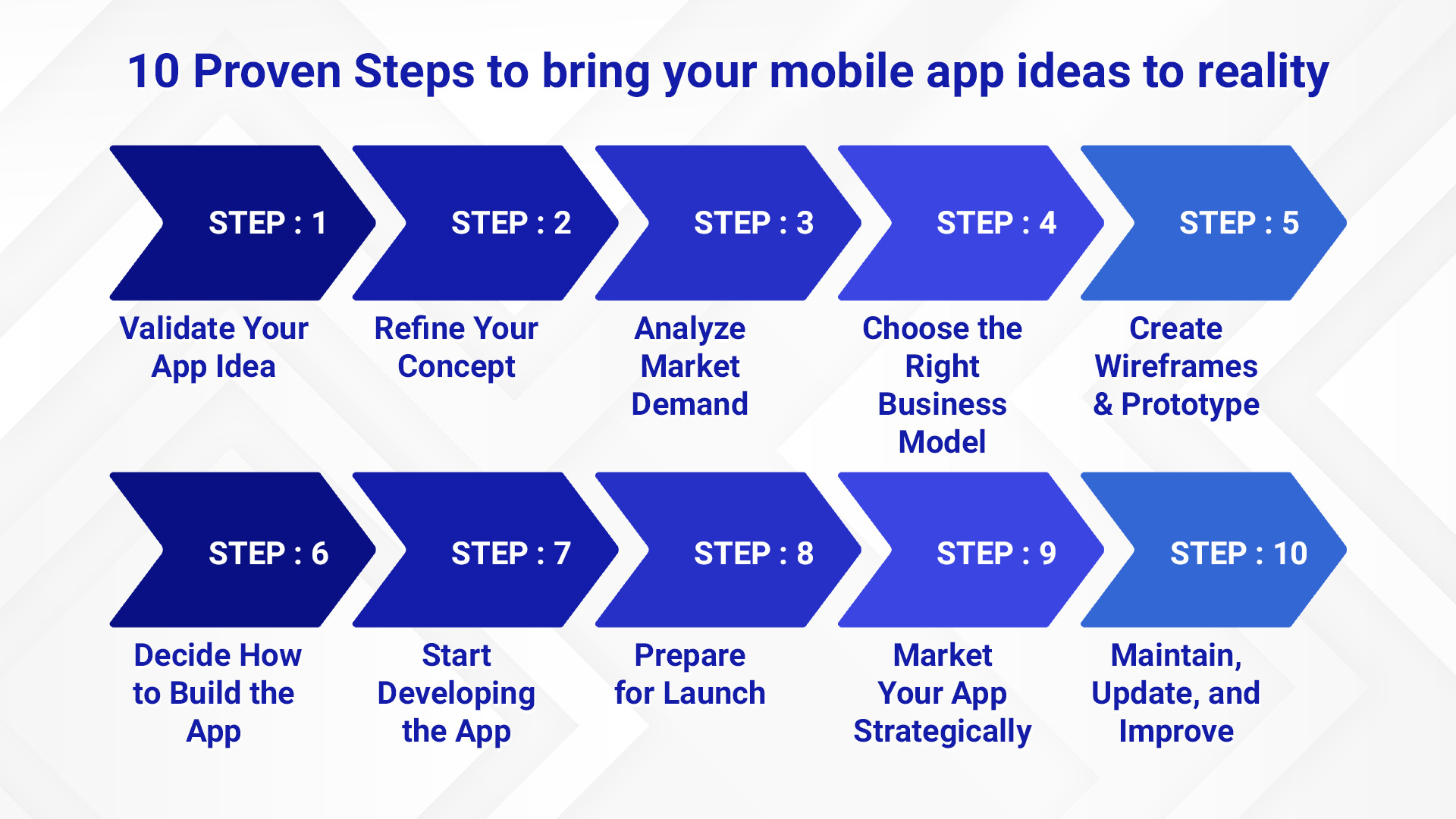
Step 1 – Validate Your App Idea
Before you think about hiring a developer or choosing features, make sure the idea solves a real need.
Understand the Core Problem
Ask yourself:
- What exact problem does this app solve?
- Why would someone choose your app over others?
- Is this something people need daily or occasionally?
The clearer this answer is, the stronger your foundation becomes. Successful mobile app ideas always solve a specific pain point or create a valuable experience.
Identify Your Target Users
Identify your target users clearly: students, busy professionals, parents, fitness lovers, or small business owners.
The more focused your target group, the more personalised your features, design, and messaging can be.
Research Your Competitors
Search for:
- Similar apps
- Related application ideas
- Top mobile apps 2025 in your category
- Gaps that others haven’t solved
Competitors are not threats, they’re guideposts. They show you what’s working and what users still want.
Step 2 – Refine Your Concept
Your raw idea now needs shaping.
Turn Thoughts Into Clear App Concepts
Write down:
- What the app does
- Who it’s for
- Why is it needed
- What makes it different
This becomes your concept note.
Define Core Features vs Extras
Think MVP (Minimum Viable Product).
Core features = Without them, the app cannot function.
Optional features = Can be added later after launch.
This helps manage cost, speed, and complexity.
Create a Simple User Journey
A user journey is a map of how someone moves through your app.
For example:
- Open the app
- Sign up
- Land on the dashboard
- Use the main feature
- Save or share output
This helps during prototyping and UI/UX design.
Step 3 – Analyze Market Demand
Even the best mobile app development ideas need real users.
Use Search Data and App Store Trends
Look for keywords like:
- Best app ideas
- New app ideas
- Apps to develop
- Easy app ideas
- Top mobile apps 2025
This reveals what the market wants.
Study Similar Apps Thoroughly
Check downloads, reviews, complaints, missing features
Negative reviews are gold – they show what users desperately want.
Identify Gaps
Look for missing features, opportunities to make the app faster, simpler, or cheaper, and user groups competitors ignore.
Your uniqueness becomes your selling point.
Step 4 – Choose the Right Business Model
Your revenue plan should be clear from day one.
Free Model
Best for apps aiming for mass adoption. Revenue comes from ads.
Subscription Model
Ideal for fitness, education, and productivity apps, offering steady recurring income.
Steady recurring income.
One-Time Purchase Model
Suitable for niche tools or utility apps.
In-App Purchases
Best for gaming apps, premium unlocks, extra features, and add-ons.
Custom App Development Model
Useful for businesses building a solution for internal teams, customers, or operations.
Step 5 – Create Wireframes and Prototype
This is where you turn imagination into structure.
Visualize Your Application Ideas
Wireframes are simple screen sketches showing layout and flow.
Tools for Creating Prototypes
- Figma
- Adobe XD
- Sketch
These tools help you build clickable mockups.
Collect Early Feedback
Share your prototype with:
- Potential users
- Friends
- Industry experts
Early feedback saves time and money later.
Turn your app idea into a market-winning product today.
Step 6 – Decide How to Build the App
This is one of the most important decisions.
Hire a Mobile App Development Company
Best for:
- Custom app development
- Complex features
- Long-term scaling
- Multiple platforms (iOS + Android)
Work with Freelancers
More budget-friendly but needs stronger management and communication.
Build With a Team Through a Startup
If you are technical or want long-term control, forming a mobile development startup is a great option.
Compare Costs, Timelines, and Expertise
Cheaper doesn’t mean better. Quality decides user trust, retention, and success.
Choose Your Tech Stack
Decide between native (Swift, Kotlin) or cross-platform (Flutter, React Native) based on your budget, development speed, scalability needs, and app complexity.
Step 7 – Start Developing the App
Now your idea starts becoming real.
Front-End + Back-End
The Front-end is what users see.
Back-end is the engine behind the app.
UI/UX Design
Users prefer apps that are simple, fast, clean, and intuitive—strong design can make even a basic app feel premium.
Testing and Quality Assurance
Testing ensures the app has no crashes, smooth performance, and easy navigation—quality makes or breaks the user experience.
Step 8 – Prepare for Launch
You’re almost there.
App Store Optimization (ASO)
Optimize your keywords, title, screenshots, and description to help your app rank higher organically.
Set Up Analytics
Use tools like Firebase to track installs, retention, user behavior, and drop-offs.
Beta Testing
Let selected users try the app before launch to fix bugs, improve user flow, and validate key features.
Step 9 – Market Your App Strategically
Building is only half the journey—getting users is equally important. See how mobile app development strategies are winning 50M users in 2025
Social Media Promotion
Promote your app on Instagram, TikTok, YouTube, and Facebook with behind-the-scenes content, app benefits, and feature highlights.
Influencer Marketing
Creators can bring huge traction if your app fits their audience.
Paid Advertising
Google Ads, Instagram Ads, and TikTok Ads help you scale faster.
Content Marketing & SEO
Write blogs targeting:
- App ideas
- Mobile app development services
- Best mobile applications
- Unique app ideas for students
Organic traffic compounds over time.
Step 10 – Maintain, Update, and Improve
Your app isn’t “done” after launch—it’s only beginning.
Release Regular Updates
Add fresh features and improvements every few weeks.
Fix Bugs Immediately
Users uninstall apps quickly if they face issues.
Track User Feedback
Use reviews, feature requests, and analytics to improve the app continuously.
Continuous improvement is how you go from a small app to a category leader.
Best App Ideas Trending in 2025
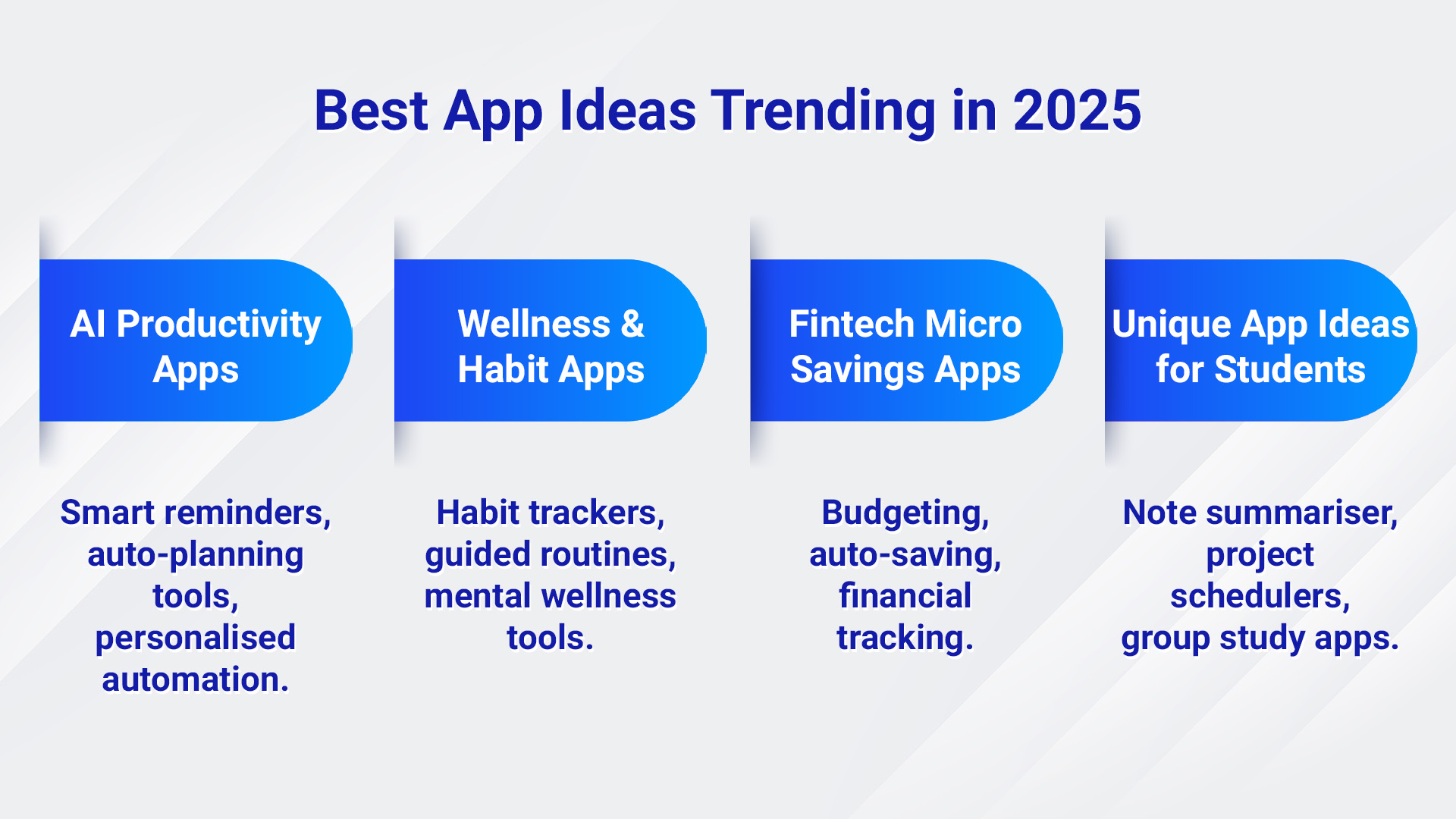
AI Productivity Apps
Smart reminders, auto-planning tools, personalised automation.
Wellness & Habit Apps
Habit trackers, guided routines, mental wellness tools.
Fintech Micro-Savings Apps
Budgeting, auto-saving, financial tracking.
Unique App Ideas for Students
Note summariser, project schedulers, group study apps.
Easy App Ideas for Beginners
- To-do list apps
- Basic expense trackers
- Simple journals
Great for first-time founders.
Conclusion
Having an app idea is just the beginning. What matters is what you do next. When you validate your concept, plan with clarity, pick the right team, and follow a structured development journey, your idea can transform into a successful mobile application.
Whether you’re aiming for a global product or building a custom app for your business, the key is consistency, research, and improvement.
Your app idea could be the next breakthrough, take the first step today.
Build a high-performing app effortlessly
FAQs
What’s the very first step after getting an app idea?
Validate your idea by understanding the problem it solves and checking if real users need it.
How long does it take to build an app?
Anywhere between 3–12 months, depending on features, complexity, and development style.
Do I need coding skills to build an app?
No. You can hire developers or use no-code tools for basic apps.
How much does app development cost?
Simple apps: $5,000–$15,000
Medium apps: $20,000–$60,000
Complex apps: $80,000+
What makes an app successful?
Clear purpose, great design, smooth performance, strong marketing, and continuous updates.
